Anxiety can feel overwhelming, especially when symptoms appear suddenly. A racing mind, restlessness, muscle tension, rapid heartbeat, difficulty concentrating, and trouble sleeping can make someone want immediate relief.
But managing anxiety effectively isn't always about finding something that makes symptoms disappear quickly.
There is an important distinction between short-term anxiety relief and long-term anxiety management.
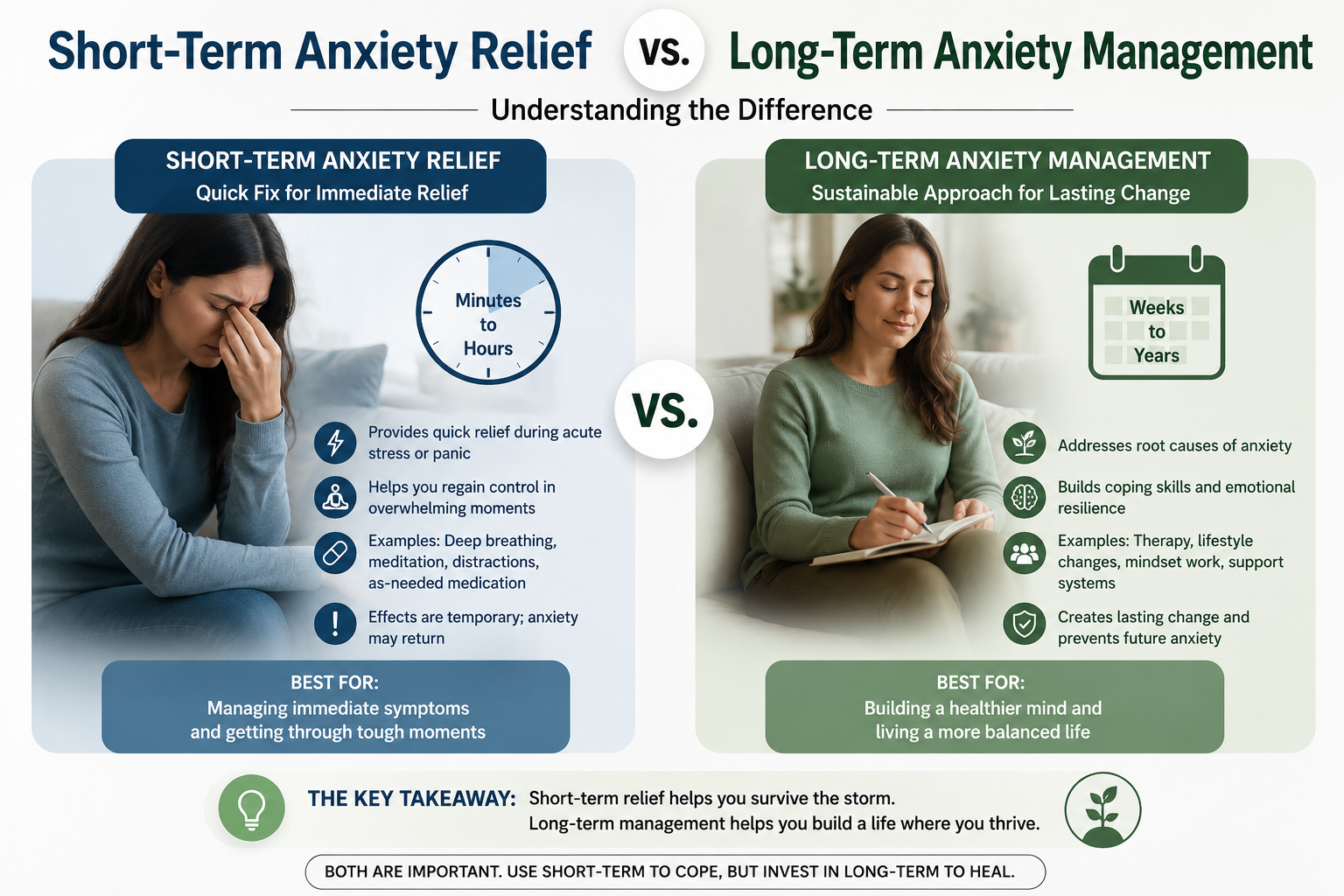
Short-term approaches may help someone cope with an acute period of anxiety, while long-term management focuses on understanding triggers, changing unhelpful patterns, improving daily habits, and using appropriate professional treatment when necessary.
Understanding the difference can help people make more informed decisions about their mental health rather than relying exclusively on immediate symptom relief.
The National Institute of Mental Health (NIMH) explains that anxiety disorders involve more than occasional worry or fear and can interfere with everyday activities, relationships, and functioning.
What Is Short-Term Anxiety Relief?
Short-term anxiety relief refers to strategies or treatments intended to reduce acute anxiety symptoms relatively quickly.
This might include:
Slow breathing exercises
Grounding techniques
Temporary removal from a stressful situation
Relaxation exercises
Talking with someone you trust
Short-term professional support
Certain prescription medications when clinically appropriate
The goal is generally to help someone get through a particularly difficult period.
For example, someone experiencing intense anxiety before an important event may benefit from breathing exercises, grounding, or other coping techniques.
However, short-term relief doesn't necessarily address why the anxiety keeps returning.
That's where long-term management becomes important.
Why Immediate Relief Can Be Appealing
When anxiety is intense, people naturally want the discomfort to stop.
Anxiety can produce very physical sensations, including:
Rapid heartbeat
Sweating
Shaking
Muscle tension
Shortness of breath
Stomach discomfort
Restlessness
Difficulty sleeping
Feeling constantly alert
When these symptoms appear suddenly, it can be difficult to think about long-term solutions.
The brain tends to prioritize the immediate problem:
"How can I feel better right now?"
That response is understandable.
However, repeatedly focusing only on immediate relief can sometimes leave underlying anxiety patterns unaddressed.
What Is Long-Term Anxiety Management?
Long-term anxiety management focuses on reducing the frequency, intensity, and impact of anxiety over time.
Rather than asking only:
"How do I stop this feeling?"
long-term management also asks:
"Why does this keep happening, and what can I change?"
Depending on the individual, long-term management may involve:
Psychotherapy
Cognitive behavioral therapy
Lifestyle changes
Regular physical activity
Improved sleep habits
Stress-management strategies
Identifying anxiety triggers
Addressing underlying medical conditions
Appropriate long-term medication when prescribed
Developing healthier responses to anxious thoughts
The NIMH information on anxiety disorders discusses psychotherapy and medication as important treatment approaches for anxiety disorders.
Short-Term Relief vs. Long-Term Management
The two approaches aren't necessarily opposites.
In many situations, they can work together.
Short-Term Anxiety Relief | Long-Term Anxiety Management |
Focuses on immediate symptoms | Focuses on ongoing patterns |
Helps during acute distress | Works toward sustained improvement |
May provide temporary calming | Builds long-term coping skills |
Often addresses "right now" | Addresses underlying contributors |
Can be useful during difficult moments | Requires consistency over time |
May involve short-term interventions | May involve therapy, lifestyle changes, and ongoing treatment |
The best approach depends on the type and severity of anxiety and the individual's circumstances.
The Role of Therapy in Long-Term Anxiety Management
Psychotherapy is one of the major approaches used to manage anxiety disorders.
One commonly used approach is cognitive behavioral therapy (CBT).
CBT can help people recognize connections among:
Thoughts → Feelings → Behaviors
For example, someone might interpret a minor physical sensation as a sign that something terrible is happening.
That interpretation increases anxiety.
The person may then begin avoiding situations or repeatedly checking their body.
The avoidance or checking can temporarily reduce uncertainty but may reinforce the belief that the situation is dangerous.
Over time, therapy can help people develop healthier ways of responding to these thoughts.
The NIMH overview of psychotherapy provides additional information about psychotherapy and how it can be used to treat mental health conditions.
Why Avoidance Can Work Against Long-Term Progress
Avoidance can provide immediate relief.
Imagine someone becomes anxious in crowded places.
They avoid the next crowded event.
Their anxiety decreases.
That can feel like success.
But the brain may learn:
"Avoiding this situation kept me safe."
The next time a crowded environment appears, anxiety may return even more strongly.
This doesn't mean everyone should immediately confront every fear. Exposure-based approaches should be appropriately structured, particularly when anxiety is severe.
But understanding the difference between temporary relief and lasting behavioral change can be an important part of treatment.
The Role of Medication
Medication may play an important role in anxiety treatment for some people.
However, different medications have different purposes, mechanisms, risks, and time courses.
Healthcare professionals may consider several categories of medication depending on the specific anxiety disorder and individual circumstances.
Benzodiazepines
Benzodiazepines include medications such as:
These medicines can produce relatively rapid calming and sedative effects and may be prescribed in specific circumstances.
However, benzodiazepines also carry risks involving misuse, addiction, physical dependence, and withdrawal.
The FDA's benzodiazepine safety communication highlights these important safety concerns.
Because of these risks, benzodiazepines aren't appropriate as a self-directed long-term solution for anxiety.
Antidepressant Medications
Some antidepressants are also used to treat anxiety disorders.
Unlike medications that may provide rapid sedation, many antidepressants used for anxiety generally require consistent use over time and may take several weeks to produce their full therapeutic effect.
Treatment should be individualized by a healthcare professional.
Why "Stronger" Medication Isn't Necessarily Better
A common misconception is that a medication that produces a stronger or faster effect must be more effective.
That's not necessarily true.
The appropriate treatment depends on:
The specific anxiety disorder
Symptom severity
Duration of symptoms
Other medical conditions
Current medications
Previous treatment response
Potential side effects
Risk of dependence or interactions
A medication that makes someone feel heavily sedated may reduce awareness of anxiety temporarily without addressing the underlying pattern.
Effective anxiety care is about appropriate treatment, not simply the strongest immediate effect.
The Importance of Sleep
Sleep and anxiety can influence each other.
Anxiety may make it difficult to fall asleep because the mind remains active.
Poor sleep can then contribute to:
This can make anxiety feel harder to manage the following day.
The National Heart, Lung, and Blood Institute explains that inadequate sleep can affect mood, attention, decision-making, and overall health.
Improving sleep therefore isn't simply a lifestyle recommendation. For some people, it can become an important part of a broader anxiety-management strategy.
Exercise and Physical Activity
Physical activity can also play a role in long-term mental health.
Regular movement may support:
Mood
Sleep
Stress management
Physical fitness
Overall well-being
Exercise isn't a replacement for professional treatment when someone has a significant anxiety disorder.
Instead, it can be one component of a broader approach.
The CDC's physical activity guidance provides general recommendations and information about the health benefits of regular physical activity.
What About Muscle Tension?
Anxiety can be accompanied by physical tension.
Some people notice tightness in their:
Repeated muscle tension can become uncomfortable and may contribute to the perception of pain.
This can create another feedback loop:
Anxiety → muscle tension → discomfort → worry → more anxiety
However, persistent or severe muscle pain shouldn't automatically be attributed to anxiety. Injuries, neurological conditions, inflammatory conditions, medication effects, and other medical issues can also cause pain.
If pain is persistent or unexplained, professional evaluation is appropriate.
Stress Management Is More Than "Relax"
People are often told to "just relax" when they're anxious.
Unfortunately, relaxation isn't always that simple.
Long-term stress management can involve identifying the specific sources of stress and changing how you respond to them.
Strategies may include:
Setting realistic boundaries
Breaking large tasks into smaller steps
Taking regular breaks
Practicing mindfulness
Maintaining social connections
Establishing consistent routines
Limiting excessive caffeine when appropriate
Creating time for enjoyable activities
The goal isn't to eliminate every stressful experience.
Instead, it's to build greater resilience and reduce the amount of time spent in a constant state of alertness.
Why Long-Term Management Takes Time
Anxiety patterns often develop gradually.
They may be influenced by:
Genetics
Life experiences
Chronic stress
Trauma
Personality factors
Medical conditions
Substance use
Sleep problems
Learned behaviors
Because these factors don't change overnight, long-term improvement usually requires consistency.
There may also be setbacks.
A stressful week doesn't necessarily mean treatment has failed.
Progress can look like:
Less frequent anxiety → faster recovery → less avoidance → better functioning.
The goal isn't necessarily to never feel anxious again.
Everyone experiences anxiety from time to time.
The goal is to prevent anxiety from controlling your life.
A Balanced Approach to Anxiety
For many people, the most useful strategy is not choosing between short-term relief and long-term management.
It's understanding when each has a role.
During acute anxiety, immediate coping strategies can help someone regain a sense of control.
Over the longer term, therapy, healthy routines, appropriate medical treatment, and learning new coping skills can help reduce anxiety's influence.
Think of it like treating a recurring problem rather than repeatedly putting out individual fires.
Short-term relief may help with today's symptoms.
Long-term management focuses on making tomorrow easier.
When Should You Talk to a Healthcare Professional?
Consider professional help if anxiety:
Continues for weeks or months
Interferes with work or school
Affects relationships
Causes persistent sleep problems
Leads to significant avoidance
Produces frequent panic symptoms
Makes everyday activities difficult
Causes significant physical symptoms
Leads to increasing reliance on sedating medication
A healthcare professional can help determine whether symptoms are related to an anxiety disorder, another medical condition, medication effects, substance use, or a combination of factors.
If you're already taking a medication such as alprazolam, lorazepam, clonazepam, or diazepam, don't abruptly stop it without medical advice. Benzodiazepine withdrawal can be serious.
Frequently Asked Questions
What is the difference between short-term anxiety relief and long-term anxiety management?
Short-term relief focuses on reducing anxiety symptoms during an acute episode. Long-term management focuses on addressing recurring anxiety through approaches such as psychotherapy, lifestyle changes, coping skills, and appropriate medical treatment.
Are anxiety medications a long-term solution?
Some medications can be appropriate for longer-term anxiety treatment, while others are generally used more cautiously because of risks such as dependence. The appropriate treatment depends on the individual's diagnosis and medical circumstances.
Do benzodiazepines provide quick anxiety relief?
Benzodiazepines can produce relatively rapid calming effects, but they carry important risks and should only be used under appropriate medical supervision.
Can therapy help with long-term anxiety?
Yes. Psychotherapy, including CBT, is an established treatment approach for anxiety disorders and can help people develop healthier ways of responding to anxious thoughts and situations.
Can poor sleep make anxiety worse?
Poor sleep can affect mood, concentration, and emotional regulation and may make anxiety more difficult to manage.
Can exercise help anxiety?
Regular physical activity can support mental and physical well-being and may be one useful component of an overall anxiety-management plan.
Should I stop taking Xanax or Ativan if I want long-term anxiety management?
Do not stop benzodiazepines abruptly without medical guidance. A healthcare professional can determine whether the medication remains appropriate and, when necessary, develop a safe discontinuation plan.
Final Thoughts
Short-term anxiety relief and long-term anxiety management serve different purposes.
When anxiety becomes intense, immediate coping strategies can help you get through the moment. But if anxiety repeatedly returns, lasting improvement usually requires looking beyond the immediate symptoms.
Therapy, healthy routines, better sleep, physical activity, stress management, and appropriate medical treatment can all have a place in a comprehensive approach.
Medications such as Ativan (lorazepam), Xanax (alprazolam), clonazepam, and Valium (diazepam) may be prescribed in certain circumstances, but their risks and benefits need to be carefully considered with a healthcare professional.
Ultimately, successful anxiety management isn't about never feeling anxious.
It's about developing the tools and support needed so that anxiety no longer determines what you can do, where you can go, or how you live your life.