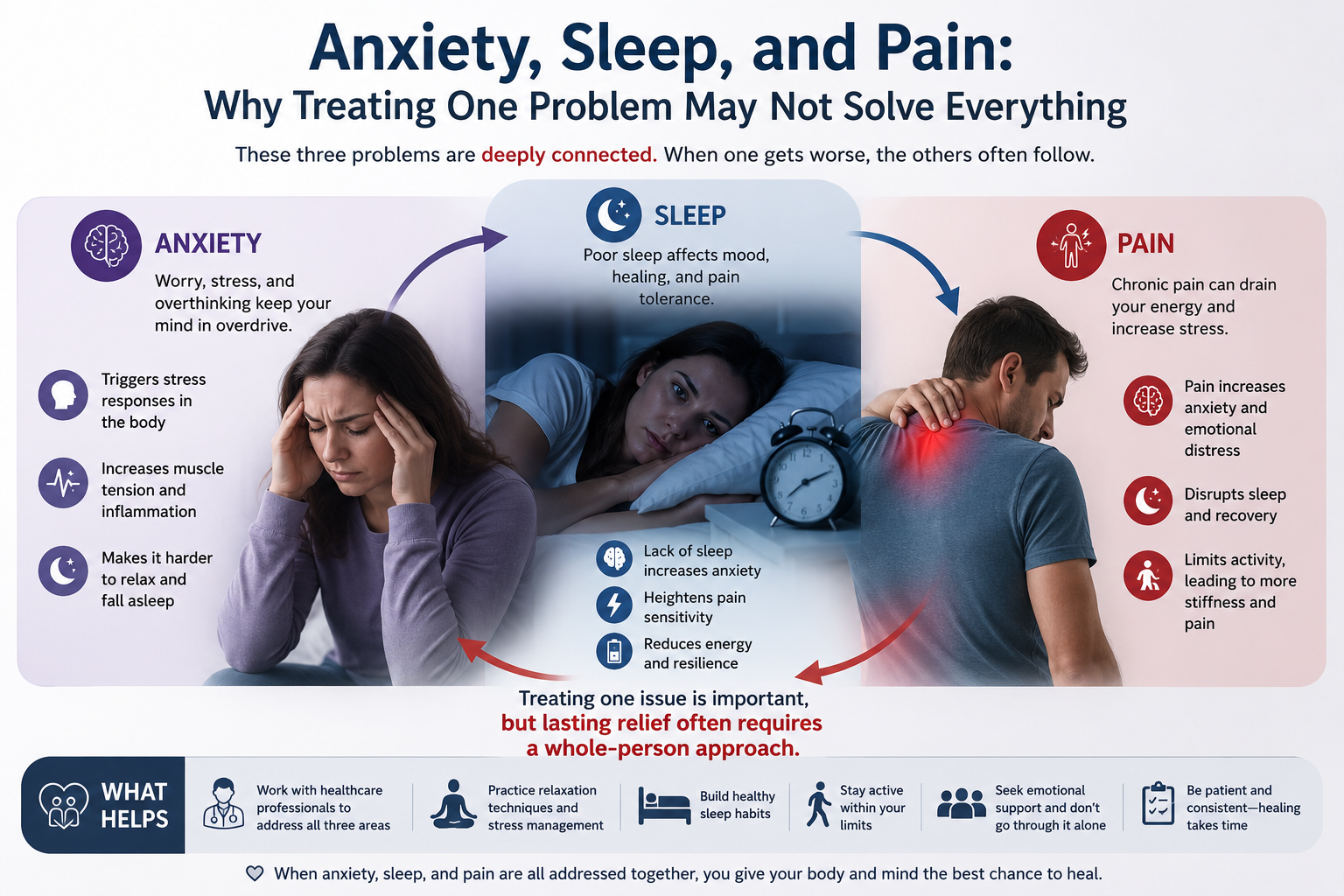
When anxiety, poor sleep, and muscle or chronic pain occur together, it can feel like you're dealing with three completely separate problems. One night you may struggle to fall asleep because your mind won't slow down. The next day, exhaustion can make your muscles feel tense and uncomfortable. Then pain itself may make it even harder to relax at bedtime.
This creates a frustrating cycle:
Anxiety → poor sleep → increased pain → more worry → worse sleep.
Breaking that cycle isn't always as simple as treating just one symptom.
Research and clinical guidance increasingly recognize that mental health, sleep, and pain can influence one another. The National Institute of Neurological Disorders and Stroke notes that chronic pain commonly occurs alongside anxiety, depression, and sleep problems, while emotional and psychological factors can also influence how pain is experienced.
Understanding these connections can help explain why someone may continue feeling unwell even after addressing only one part of the problem.
The Mind-Body Connection Is More Complicated Than It Seems
Anxiety isn't only an emotional experience.
When the brain perceives a threat, whether that threat is physical or psychological, the body can respond with increased alertness, muscle tension, faster breathing, and changes in heart rate.
Occasional anxiety is a normal response to stressful situations. However, anxiety disorders involve more persistent or excessive anxiety that can interfere with everyday life. The National Institute of Mental Health's anxiety information explains that anxiety disorders involve more than occasional worry or fear.
For someone already experiencing muscle or chronic pain, prolonged stress may make physical discomfort more noticeable.
The result can be a feedback loop:
Worry creates physical tension.
Physical tension contributes to discomfort.
Discomfort makes relaxation harder.
Difficulty relaxing interferes with sleep.
Poor sleep can make the next day's stress and pain harder to manage.
This doesn't mean anxiety is "causing everything." Pain can have many physical causes and should not automatically be attributed to stress.
Instead, the important point is that multiple factors can influence one another at the same time.
Why Sleep Matters So Much
Sleep is often treated as something separate from mental and physical health.
In reality, sleep affects many aspects of daily functioning.
When sleep is repeatedly interrupted, a person may notice:
The National Institutes of Health notes that chronic sleep problems have been linked with anxiety, depression, mental distress, and pain.
This helps explain why simply treating anxiety or pain may not completely resolve someone's symptoms if significant sleep disruption remains.
Poor Sleep Can Become Part of the Problem
Imagine someone with persistent muscle pain.
During the evening, they become worried about whether they'll sleep comfortably. They spend more time monitoring their body and anticipating discomfort.
They eventually fall asleep but wake repeatedly.
The following morning, they're exhausted.
Because they're tired, normal responsibilities feel more difficult. They may become more irritable or stressed, move less than usual, or have greater difficulty coping with discomfort.
That night, the same concerns return.
The cycle begins again.
Pain Can Make Sleep Difficult
Pain doesn't conveniently disappear when bedtime arrives.
A sore back, stiff neck, aching shoulders, joint discomfort, or other persistent pain can make it difficult to find a comfortable sleeping position.
Pain may also cause nighttime awakenings.
The National Institute on Aging explains that chronic pain can interfere with daily activities and disturb sleep, while also being associated with anxiety and depression.
This is one reason pain management isn't simply about reducing a pain score.
Healthcare professionals may also consider:
Sleep quality
Mood
Physical activity
Stress
Mobility
Medication effects
Daily functioning
Treating pain while ignoring severe sleep disruption may leave an important part of the problem unaddressed.
Anxiety Can Interfere With Sleep in Different Ways
Anxiety doesn't affect everyone in exactly the same way.
Some people experience racing thoughts.
Others repeatedly worry about future events.
Some become highly focused on bodily sensations.
Others feel restless or physically tense.
Common sleep-related experiences may include:
Difficulty falling asleep
Waking during the night
Waking earlier than intended
Feeling unable to "switch off"
Worrying about not getting enough sleep
Feeling exhausted the next day
The frustrating part is that worrying about sleep can itself become another source of anxiety.
A person may think:
"If I don't sleep tonight, tomorrow will be terrible."
That thought can increase alertness rather than relaxation.
The Anxiety–Sleep–Pain Cycle
Consider this example.
Step 1: Anxiety increases alertness
A stressful day leaves someone mentally activated at bedtime.
Step 2: Sleep becomes difficult
The person lies awake thinking about problems, responsibilities, or physical sensations.
Step 3: Fatigue develops
After several nights of inadequate sleep, daytime energy decreases.
Step 4: Pain becomes harder to manage
Normal muscle discomfort may feel more intrusive when someone is exhausted.
Step 5: The person becomes concerned about the pain
They begin wondering whether something is seriously wrong.
Step 6: Anxiety increases
More worry produces greater mental and physical tension.
Step 7: Sleep becomes difficult again
The cycle continues.
This is why treating only one element may not always produce the expected improvement.
Does Poor Sleep Actually Affect Pain?
The relationship between sleep and pain appears to go in both directions.
Pain can disrupt sleep, while sleep disturbance can also be associated with greater pain and disability.
NIH research information describes sleep disturbance as being linked with pain and disability, including in people with arthritis.
Research published through PubMed has also found relationships among pain severity, pain interference, sleep quality, and depression in people living with chronic pain.
This doesn't mean that improving sleep will automatically eliminate chronic pain.
Rather, it suggests that sleep may be one important part of a broader pain-management strategy.
Why Treating Anxiety Alone May Not Be Enough
Suppose someone receives effective treatment for anxiety but continues sleeping poorly because of chronic pain.
Their anxiety symptoms might improve, yet fatigue and discomfort may continue.
Conversely, someone may receive treatment for pain but remain highly anxious at bedtime.
Their physical symptoms may improve somewhat, but sleep may remain disrupted.
This is why healthcare professionals often need to look at the whole picture rather than focusing exclusively on one symptom.
The National Institute of Mental Health notes that anxiety treatment may involve psychotherapy, medication, or both, with treatment choices based on individual needs and medical circumstances.
Why Treating Pain Alone May Not Be Enough
Pain can have physical, neurological, psychological, and behavioral dimensions.
That doesn't mean pain is imaginary or "all in your head."
Pain is real.
However, the brain plays an important role in processing pain signals, and emotional state can influence the experience of pain.
The National Institute of Neurological Disorders and Stroke explains that the systems involved in pain, mood, emotions, and some mental health conditions overlap.
Consequently, effective pain care may involve more than medication.
Depending on the cause, a healthcare professional may recommend approaches such as:
What About Depression?
Depression can add another layer to the anxiety–sleep–pain relationship.
Persistent pain can make people withdraw from activities they previously enjoyed.
Poor sleep can reduce energy.
Reduced energy can make exercise, socializing, work, or hobbies feel more difficult.
Over time, this can contribute to low mood and isolation.
At the same time, depression itself can involve changes in sleep, energy, concentration, and motivation.
The National Institute of Mental Health's depression guidance explains that depression treatment commonly involves psychotherapy, medication, or both, depending on the person's circumstances.
This is another reason a person experiencing pain, insomnia, anxiety, and low mood may benefit from a comprehensive assessment rather than treating each symptom independently.
Where Do Medications Fit In?
Medication can be an important component of treatment for some people, but the right medication depends on the diagnosis and individual circumstances.
For anxiety, healthcare professionals may consider several medication categories, including antidepressants and, in some circumstances, benzodiazepines. NIMH notes that benzodiazepines can rapidly reduce anxiety but may lead to tolerance and dependence, which is one reason clinicians may use them for limited periods.
Medications such as Ativan (lorazepam), Xanax (alprazolam), clonazepam, and Valium (diazepam) belong to the benzodiazepine class.
Other medicines may be used for sleep or pain depending on the underlying condition.
However, medications that cause sedation can interact with one another.
This is especially important when someone is using several medications that affect the central nervous system.
For example, combining benzodiazepines with opioids can create serious safety risks. Medication decisions should therefore be made with a healthcare professional who knows the person's complete medication list.
Why Medication Isn't Always the Whole Solution
Medication can address particular symptoms, but it may not address every factor contributing to the problem.
Someone may still need help with:
Psychotherapy can be useful for anxiety and depression, and approaches such as cognitive behavioral therapy can help people identify and change unhelpful thought and behavior patterns.
In some cases, psychological treatment can also be incorporated into a broader approach to chronic pain management.
Practical Ways to Address the Three-Way Connection
You don't necessarily have to change everything at once.
Small, consistent changes can be easier to maintain.
1. Establish a Consistent Sleep Schedule
Going to bed and waking up at roughly consistent times can help create a predictable routine.
2. Pay Attention to Caffeine
Caffeine can interfere with sleep for some people. If anxiety or insomnia is a concern, consider discussing caffeine intake with a healthcare professional.
3. Keep Moving Within Your Abilities
Appropriate physical activity can support physical and mental health. If pain limits movement, a healthcare professional or physical therapist can help determine appropriate activity.
4. Don't Ignore Persistent Pain
Pain that continues, worsens, or interferes substantially with daily life deserves medical evaluation.
5. Address Anxiety Directly
Relaxation exercises, psychotherapy, stress-management techniques, and appropriate medical treatment may help depending on the cause.
6. Look at the Whole Medication List
Tell your doctor and pharmacist about every medication, supplement, and substance you use.
This is particularly important if you take medicines for anxiety, sleep, or pain.
7. Don't Assume Every Symptom Is Psychological
Anxiety can produce physical symptoms, but persistent pain or significant sleep problems can also have underlying medical causes.
A proper evaluation matters.
When Should You Seek Professional Help?
Consider speaking with a healthcare professional if anxiety, pain, sleep problems, or low mood are:
Persistent
Getting worse
Interfering with work or school
Affecting relationships
Preventing normal activities
Causing significant daytime fatigue
Leading you to rely increasingly on medication
Making you feel hopeless or unable to cope
The National Institute of Mental Health's mental-health guidance recommends seeking professional help when symptoms interfere with daily life or persist.
If someone is experiencing thoughts of suicide or self-harm, immediate professional help is important. In the United States, the 988 Suicide & Crisis Lifeline is available by call or text at 988.
Frequently Asked Questions
Can anxiety cause muscle pain?
Anxiety can be associated with physical symptoms such as muscle tension, but persistent muscle pain can have many possible causes. Ongoing or unexplained pain should be evaluated by a healthcare professional.
Can poor sleep make pain feel worse?
Sleep and pain influence one another. Research and NIH resources describe associations between sleep disturbance, pain, and disability.
Can pain cause anxiety?
Living with persistent pain can contribute to worry, frustration, stress, and anxiety. Pain can also interfere with sleep and daily activities, which may further affect emotional well-being.
Can anxiety and depression affect sleep?
Yes. Anxiety and depression can both be associated with sleep difficulties. Persistent sleep changes should be discussed with a healthcare professional, particularly when they affect daytime functioning.
Should anxiety, sleep problems, and pain be treated separately?
Not necessarily. These problems can influence one another, so a comprehensive treatment plan may address multiple factors at the same time.
Can medication treat anxiety, pain, and sleep problems?
Different medications target different conditions, and some medicines may affect more than one symptom. However, medication selection should be individualized and supervised by a healthcare professional because interactions and side effects can occur.
Final Thoughts
Anxiety, sleep problems, and pain aren't always isolated conditions.
They can form a complicated feedback loop in which each problem makes the others harder to manage:
Anxiety can interfere with sleep.
Poor sleep can make coping with pain more difficult.
Pain can disrupt sleep and increase emotional distress.
Ongoing distress can make anxiety and sleep problems harder to manage.
That doesn't mean every person with anxiety has pain, or that every pain problem is caused by stress. Instead, it highlights why looking at the whole person can be more useful than focusing on a single symptom.
Effective treatment may involve a combination of medical evaluation, appropriate medication when indicated, psychotherapy, physical activity, sleep improvements, and practical strategies for managing stress.
The goal isn't simply to eliminate one symptom. It's to understand how the different pieces fit together and develop a treatment approach that addresses the person's overall health.